
- Home
- Truck Accident Lawyer
- Truck Accident Information
- Resources
- Contact
- CALL US NOW
Truck accidents in Rhode Island may occur in a smaller geographic area compared to other states, but the consequences are often just as devastating. As a critical connector for New England commerce, Rhode Island sees a constant flow of commercial trucks traveling through dense urban corridors, ports, and interstate highways. When a collision involves an 18-wheeler or commercial truck, the injuries, damages, and legal complexities can quickly become overwhelming. If you or a loved one has been harmed, working with an experienced Rhode Island truck accident lawyer is essential to protecting your rights and pursuing full compensation.
This article provides a comprehensive overview of Rhode Island truck accident law, including state-specific legal rules, statutes of limitations, major trucking corridors, what makes truck accidents unique in the Ocean State, and why legal representation matters.
Truck accident claims in Rhode Island are governed by state personal injury law alongside federal trucking regulations. Because commercial trucks are subject to strict safety standards, violations of these rules often play a central role in determining liability.
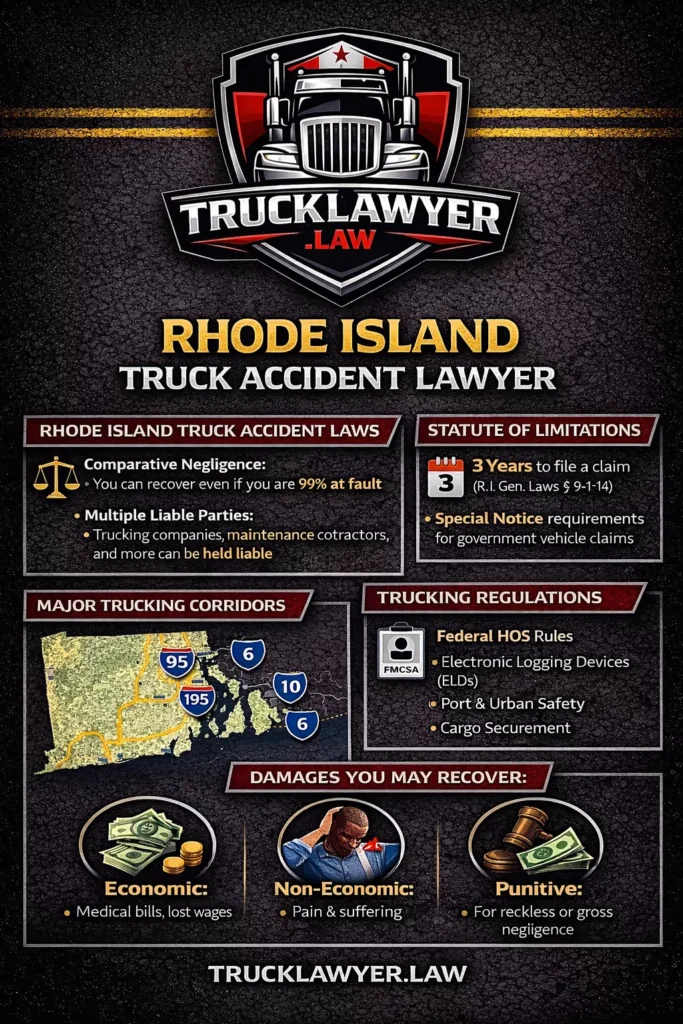
Rhode Island follows a pure comparative negligence system, which is more favorable to injured victims than the laws in many other states. Under this rule:
For example, if you are awarded $500,000 but found 40% responsible, you may still recover $300,000. Insurance companies often attempt to exaggerate a victim’s fault to reduce payouts, which is why a skilled Rhode Island truck accident lawyer is critical.
Truck accidents frequently involve multiple liable parties. Under Rhode Island law, responsible parties may include:
Identifying every potentially liable party is essential to maximizing compensation.

Rhode Island law strictly limits how long victims have to file a truck accident lawsuit.
Under R.I. Gen. Laws § 9-1-14, personal injury claims—including truck accident cases—must be filed within:
This is longer than many states, but delays can still jeopardize evidence and witness testimony.
If a truck accident involves a state or municipal vehicle, special notice requirements may apply, often requiring notice within a much shorter timeframe.
Failing to file within the statute of limitations can permanently bar your claim. A Rhode Island truck accident lawyer ensures all deadlines are met and your case is properly filed.
Despite being the smallest state in the U.S., Rhode Island plays an outsized role in regional trucking and freight transportation.
Key trucking corridors include:
These highways often experience congestion, tight merging areas, and frequent construction—conditions that increase the risk of serious truck accidents.

Truck accident liability often hinges on violations of trucking regulations, both federal and state-level.
Commercial trucks operating in Rhode Island must comply with FMCSA regulations, including:
Violations of these regulations can serve as powerful evidence of negligence.
Rhode Island also enforces:
A Rhode Island truck accident lawyer will investigate inspection reports, logbooks, black box data, and maintenance records to uncover violations.
Truck accidents in Rhode Island present unique challenges due to the state’s size, infrastructure, and traffic patterns.
Cities like Providence, Pawtucket, and Warwick feature narrow streets, tight intersections, and heavy pedestrian traffic. Large commercial trucks navigating these areas increase the risk of:
Rhode Island’s ports and industrial zones generate significant truck traffic, including container trucks and fuel carriers. Accidents involving these vehicles often involve:
Because Rhode Island is geographically compact, trucking routes overlap heavily with commuter traffic. This congestion increases the likelihood of multi-vehicle crashes and chain-reaction collisions.
Truck accident injuries are often severe and life-altering. Rhode Island law allows victims to pursue compensation for both economic and non-economic losses.
In cases involving reckless or willful misconduct, such as drunk driving or extreme safety violations, Rhode Island courts may award punitive damages to punish wrongdoing and deter future misconduct.
Truck accident cases are complex, high-stakes, and aggressively defended by trucking companies and insurers.
Commercial carriers often deploy investigators immediately after a crash. Without legal representation, critical evidence—such as black box data or driver logs—may be lost or destroyed.
A skilled Rhode Island truck accident lawyer knows how to:
Truck accident injuries often require ongoing medical care and may permanently impact your ability to work. An experienced lawyer ensures your claim reflects the full, long-term cost of your injuries—not just immediate expenses.

If you or a loved one has been injured in a collision with a commercial truck, you deserve strong legal representation. A knowledgeable Rhode Island truck accident lawyer can protect your rights, hold negligent parties accountable, and fight for the compensation you need to move forward.
Truck accident cases are time-sensitive and evidence-driven. The sooner you speak with an attorney, the stronger your case can be.
Contact us today for a free case evaluation!